
Encryption Algorithms
Introduction
Section titled “Introduction”Core applications
Section titled “Core applications”Communications
- E2EE is becoming standard for direct messaging
- TLS/SSL (HTTPS), SSH, instant messaging
- Used to store secret data, or to message authorized parties
- A core part of IPsec (routing, DNS, tunneling)
- The PGP suite allows both encryption and signing
Credentials
- Confirming someone is who they say they are
- Account passwords, local and cloud
- The 802.11 suite: WPA2, WPA3
- Authentication: EAP, MSCHAPv2
- Disk and file encryption
Encryption types
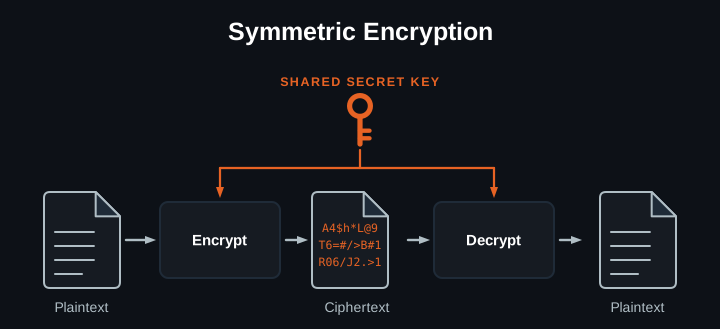
Section titled “Encryption types”Symmetric
- The key is pre-shared between client and recipient
- The same key both encrypts and decrypts the message
- Extremely fast, and hardware-accelerated
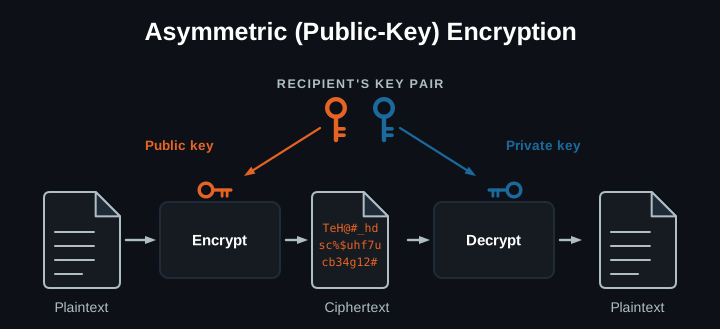
Asymmetric (public-key)
- Two keys, public and private
- Often used to exchange credentials or verify authenticity
- Encryption: encrypt with the recipient’s public key. Only their private key can decrypt it
- Authentication: sign with your private key, and anyone holding your public key can verify it
Key types
Section titled “Key types”| Type | Relies on | |
|---|---|---|
| RSA (Rivest-Shamir-Adleman) | Asymmetric | Factorization of large numbers, and modular arithmetic |
| AES (Advanced Encryption Standard) | Symmetric block cipher | Confusion and diffusion |
| ECC (Elliptic Curve Cryptography) | Asymmetric | The elliptic curve discrete logarithm problem (ECDLP) |
Key generation
Section titled “Key generation”RSA rests on a trapdoor function: easy to produce, difficult to reproduce.
N = p × q, where p and q are large primes.
Euler’s totient function φ(n) counts the positive integers up to n that are relatively prime to n, the ones sharing no factor with n other than 1.
For n = 9, the integers are {1,2,3,4,5,6,7,8,9}. Those with a common factor
are {3,6,9}, leaving totatives {1,2,4,5,7,8}, so φ(9) = 6.
For n = 15, since 15 = 3 × 5 and both are prime,
φ(15) = φ(3) × φ(5) = (3−1) × (5−1) = 2 × 4 = 8, with totatives
{1,2,4,7,8,11,13,14}.
Implementation
Section titled “Implementation”- Compute
N = p × q - Compute
φ(N) = (p−1)(q−1) - Public exponent: choose
ewith1 < e < φ(N)andgcd(e, φ(N)) = 1 - Private exponent:
dwheree × d ≡ 1 (mod φ(N)) - Public key is
(N, e); private key is(N, d) - Encryption:
C = Mᵉ (mod N) - Decryption:
M = Cᵈ (mod N)
Worked through with p = 3 and q = 11:
n   = 3 × 11 = 33φ(n) = (3−1)(11−1) = 20e   = 3            gcd(3, 20) = 1d   = 7            3d ≡ 1 (mod 20)
Public key (33, 3)   Private key (33, 7)
Encrypt m = 7:   c = 7³  (mod 33) = 343 (mod 33) = 13Decrypt c = 13:  m = 13⁷ (mod 33) = 7
The decryption step is cheaper than it looks, because you never compute 13⁷ in full. You reduce as you go:
13¹ ≡ 13 (mod 33)13² ≡ 169 ≡ 4 (mod 33)13⁴ ≡ 4² ≡ 16 (mod 33)13⁷ = 13⁴ · 13² · 13¹ ≡ 16 · 4 · 13 (mod 33) ≡ 64 · 13 ≡ (−2) · 13 ≡ −26 ≡ 7 (mod 33)Specs and tradeoffs
Section titled “Specs and tradeoffs”- Typical key sizes: 2048-bit is the current standard, 4096-bit for high security
- Primes p and q: hundreds of digits long, so 300+ digits for a 2048-bit key
- Common public exponent: usually 65537 (2¹⁶ + 1)
| Advantages | Disadvantages |
|---|---|
| Simple and versatile | Computationally expensive |
| Proven reliable, in use since 1977 | Large key sizes |
| Hardware accelerated | Easy to predict, so there are side-channel risks |
| Asymmetric | Quantum threat |
Block cipher algorithm
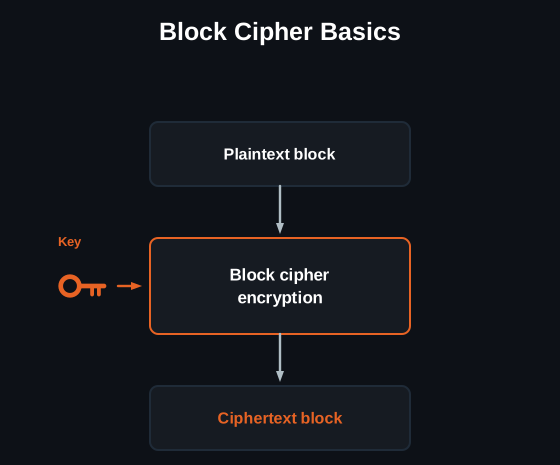
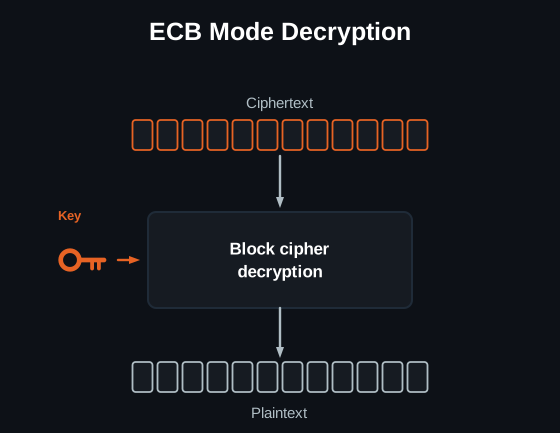
Section titled “Block cipher algorithm”A block cipher takes a fixed-length block of plaintext and a secret key, and transforms them into a block of ciphertext of the same length.
- Block size: commonly 64 or 128 bits. Messages shorter than the block are padded.
- Rounds: the algorithm performs a series of repetitive operations, such as substitution and diffusion.
Confusion and diffusion
Section titled “Confusion and diffusion”Confusion substitutes each byte through a nonlinear lookup table (the S-box), which makes the relationship between key and ciphertext complex and unpredictable. A Caesar cipher is the toy version:
Text: ABCDEFGHIJKLMNOPQRSTUVWXYZShift: 23Cipher: XYZABCDEFGHIJKLMNOPQRSTUVWDiffusion shuffles and mixes bytes across the block. The avalanche
effect is the result: a single changed input bit affects roughly half the
output bits after a few rounds. The toy version is a transposition, where
abcd becomes dabc.
How AES works
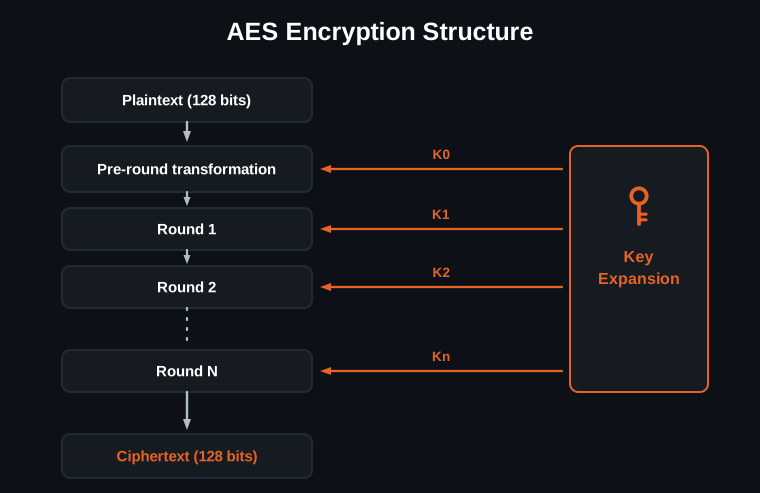
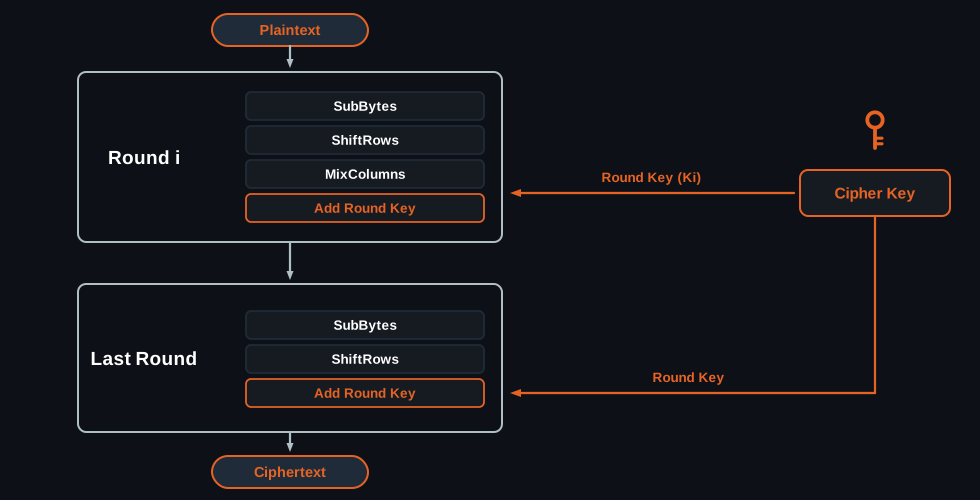
Section titled “How AES works”- Symmetric algorithm
- Key sizes: 128, 192, or 256 bits
- Block size: fixed at 128 bits
- Structure: a substitution-permutation network (SPN)
- Rounds: 10 for 128-bit keys, 12 for 192-bit, 14 for 256-bit
Uses and tradeoffs
Section titled “Uses and tradeoffs”- File encryption: securing hard drives
- Secure communication: encrypting the TLS/SSL data stream
- Wireless security: WPA2 and WPA3
- Government standards: Top Secret data protection globally
| Advantages | Disadvantages |
|---|---|
| Speed | Key distribution |
| Secure | Implementation complexity |
| Hardware accelerated | Low memory |
Math refresh
Section titled “Math refresh”Linear (continuous) logarithms are the inverse of exponents. Given
bˣ = y, the logarithm asks which exponent x produces y from base b. The power
rule gives log(bˣ) = x · log(b), so x = log(y) / log(b). Given 2ˣ = 32,
x = log(32)/log(2) = 5.
Modular (discrete) logarithms ask the same question inside a modulus: given
gˣ ≡ y (mod n), find x. The power rule no longer applies, and this is the
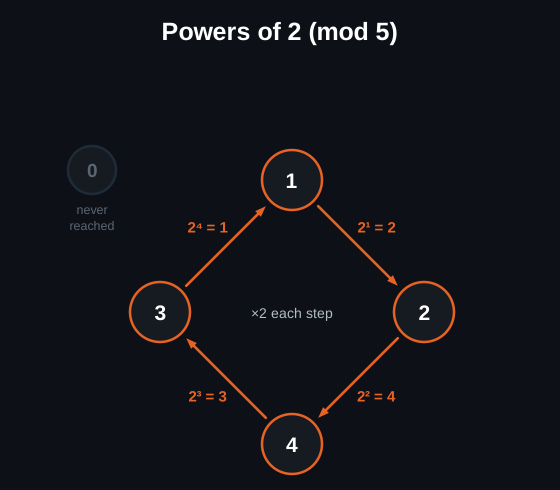
discrete logarithm problem (DLP). For small numbers it is relatively easy. Take y = 3 and g = 2 (mod 5) and find x by hand. For large numbers it is
impossible.
Discrete logarithms
Section titled “Discrete logarithms”Successive powers of g = 2 modulo n = 5:
2¹ ≡ 2 (mod 5)2² ≡ 4 (mod 5)2³ ≡ 3 (mod 5) 8 = 1 × 5 + 32⁴ ≡ 1 (mod 5) 16 = 3 × 5 + 12⁵ ≡ 2 (mod 5) cycle repeatsThe outputs follow no predictable order. For a 256-bit modulus the cycle length is astronomically large, and the security rests on the computational inefficiency of working backwards through it.
Elliptic curves
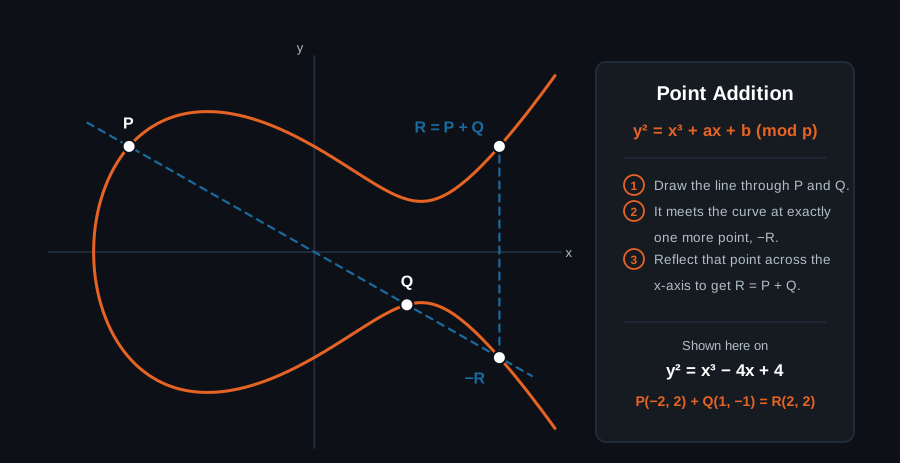
Section titled “Elliptic curves”An elliptic curve is defined as y² = x³ + ax + b (mod p), where a, b, and p
are the parameters that pick out the specific curve. Only discrete integer
coordinate pairs (x, y) are valid points for cryptography.
Point addition: given two points A and B, their sum A + B is found by
drawing a line through A and B. That line makes a third intersection with the
curve, and that point is then reflected across the x-axis.
ECC encryption
Section titled “ECC encryption”Scalar multiplication is the repeated addition of a point to itself:
P = k × G, where G is the generator point and k is the scalar.
- Private key:
k, a randomly chosen large integer, kept secret - Public key:
P, the resulting point, shared openly
The elliptic curve discrete logarithm problem (ECDLP) is what makes this useful. Computing P from k and G is fast; the reverse has no known sub-exponential algorithm for elliptic curves.
Conclusion
Section titled “Conclusion”Relevance for security
Section titled “Relevance for security”- End-to-end encryption means only you and your recipient can read your messages, not your ISP, the app company, or anyone else
- It protects you on networks you cannot control, such as public WiFi or an employer or school network
- It secures sensitive transactions, and is the backbone of trust in digital communications
- Encrypted authentication keeps your identity yours
- It protects your information even when companies get breached
Logjam (2015) was an attack on live TLS connections that exploited outdated policy together with mathematical precomputation. It demonstrated that a theoretical weakness can translate into a real, scalable attack. TLS still supported weak encryption standards at the time; using Number Field Sieve precomputation, a 512-bit key could be broken in a week. Most servers used the same set of shared primes, so a one-time computation cost could instantly break thousands of machines.
Mesh networking relevance
Section titled “Mesh networking relevance”- Key distribution: nodes join and leave a mesh dynamically, which makes safe distribution and routing difficult
- Most mesh networks rely on asymmetric approaches for the handshake, then symmetric encryption (AES) for bulk data
- Multi-hop exposure: every hop is a potential interception point, so E2EE is necessary
- Node authentication: RSA or ECC signatures prove identity without sharing a secret
Future considerations
Section titled “Future considerations”- Shor’s algorithm is a quantum algorithm for finding the prime factors of an integer, and both RSA and ECC are vulnerable to it
- As quantum computing develops rapidly, quantum-resistant standards become necessary
- Post-quantum cryptography: NIST finalized standards in 2024, relying on the difficulty of lattice problems
- Migration to PQC is complex, and touches hardware, mesh networks, and existing infrastructure
Sources
Section titled “Sources”- Symmetric vs Asymmetric Key Encryption (GeeksforGeeks)
- RSA Algorithm in Cryptography (GeeksforGeeks)
- Euler’s Totient Function (GeeksforGeeks)
- Advanced Encryption Standard (AES) (GeeksforGeeks)
- Block Cipher Modes of Operation (GeeksforGeeks)
- Difference between Confusion and Diffusion (GeeksforGeeks)
- Elliptic Curve Cryptography (GeeksforGeeks)
- Trapdoor function (Wikipedia)
- RSA (cryptosystem) (Wikipedia)
- Discrete logarithm (Wikipedia)
- Elliptic-curve cryptography (Wikipedia)
- Logjam (Wikipedia)
- Shor’s algorithm (Wikipedia)
- Post-quantum cryptography (Wikipedia)
Diagrams on this page were made with Claude. Everything else is researched and written by club members.
Built with the help of Claude. All content is written and reviewed by club members.
Auburn University Mesh Club ·Source on GitHub