
MeshCore vs. Meshtastic
A brief history
Section titled “A brief history”Meshtastic, the OG
Section titled “Meshtastic, the OG”Launched in 2019 as a solo effort by Kevin Hester, who wanted a better way to do off-grid comms for outdoor activities.
- 2020: prototyping with T-Beam boards
- 2021: expansion to new hardware (RAK boards, T-Echo) and use in emergency communications
- 2022: many new features and improvements: better routing, encryption, MQTT, and a Python API
- 2025: version 2.6 ships a new routing algorithm, more similar to MeshCore’s
MeshCore, the new kid
Section titled “MeshCore, the new kid”MeshCore was developed most directly as a response to Cyclone Gabrielle in New Zealand, as a backup for when normal communication methods go down.
Its developers looked at Meshtastic and aimed to solve its most apparent problem: too many nodes in one area flood the network. 2025 saw rapid growth of the platform as people observed the superior routing in dense areas.
The routing solutions
Section titled “The routing solutions”Meshtastic: flood always
Section titled “Meshtastic: flood always”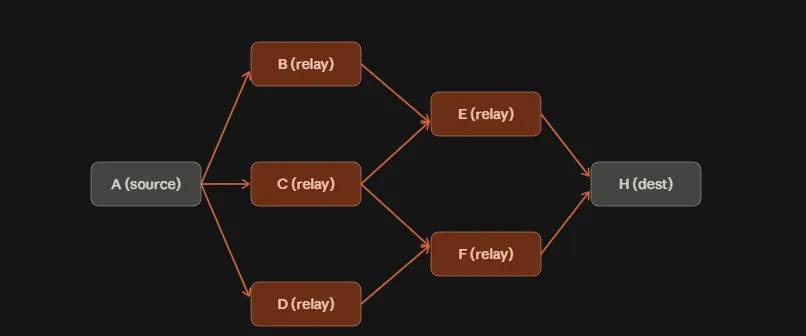
Every communication floods until the hop limit is hit. That allows many paths from sender to receiver, and it works great in small groups.
MeshCore: flood first, then route
Section titled “MeshCore: flood first, then route”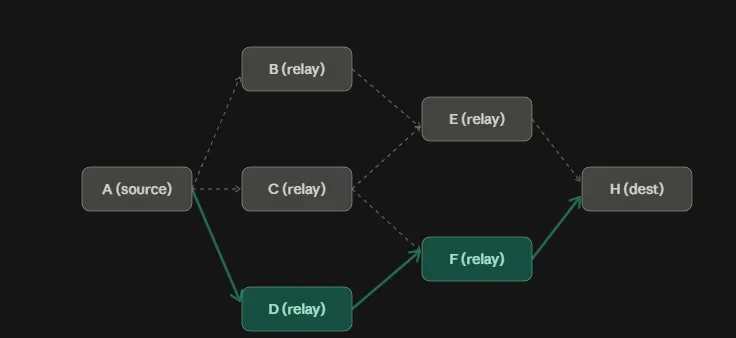
MeshCore floods on the first message to find a route, saves the route it found, and then chooses that path going forward. It retries a flood after roughly four failed attempts. This cuts down on messages flooding the network every time.
Which to choose? Both
Section titled “Which to choose? Both”Choose Meshtastic when
Section titled “Choose Meshtastic when”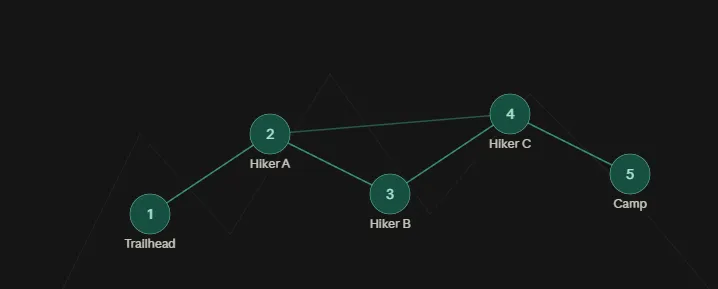
- Only a few nodes are required to let everyone on the network communicate
- Hiking, concerts, field days, any outdoor activity with a small group of mobile people
Choose MeshCore when
Section titled “Choose MeshCore when”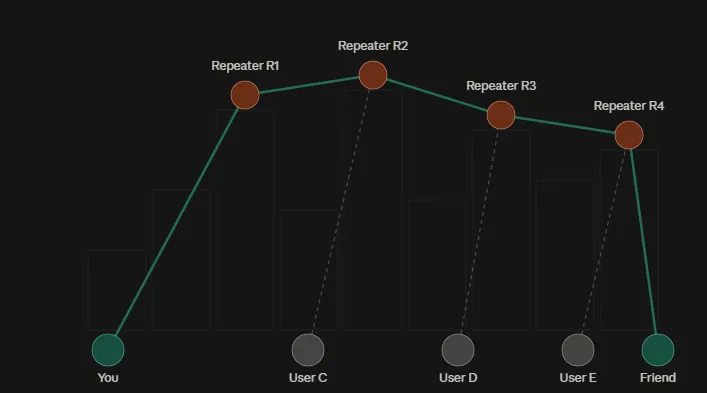
- Planning a more permanent, city-wide network
- A large number of nodes need to be connected to the network
- Repeater infrastructure is set up
Diagrams on this page were made with Claude. Everything else is researched and written by club members.
Built with the help of Claude. All content is written and reviewed by club members.
Auburn University Mesh Club ·Source on GitHub